Across Australia, pool managers face growing pressure to maintain safer and clearer water—whether it’s at a commercial aquatic centre, a hotel pool, a community facility, or a backyard system. Rising bather loads, hotter seasons, and evolving compliance requirements all demand a more rigorous and data-driven approach to water testing.
At the centre of this routine are three essential parameters: chlorine, pH, and turbidity. Together, they determine sanitisation effectiveness, water clarity, equipment longevity, and swimmer safety. And the accuracy of your testing tools can make the difference between proactive control and costly corrective action.
This is why operators across the country rely on trusted pool chlorine test kit Australia solutions, high-quality swimming pool test kits Australia, and advanced pool water testing equipment Australia—particularly those offered by LaMotte Pacific. With decades of expertise in analytical chemistry and pool instrumentation, LaMotte delivers professional-grade testing that fits seamlessly into both daily and advanced monitoring routines.
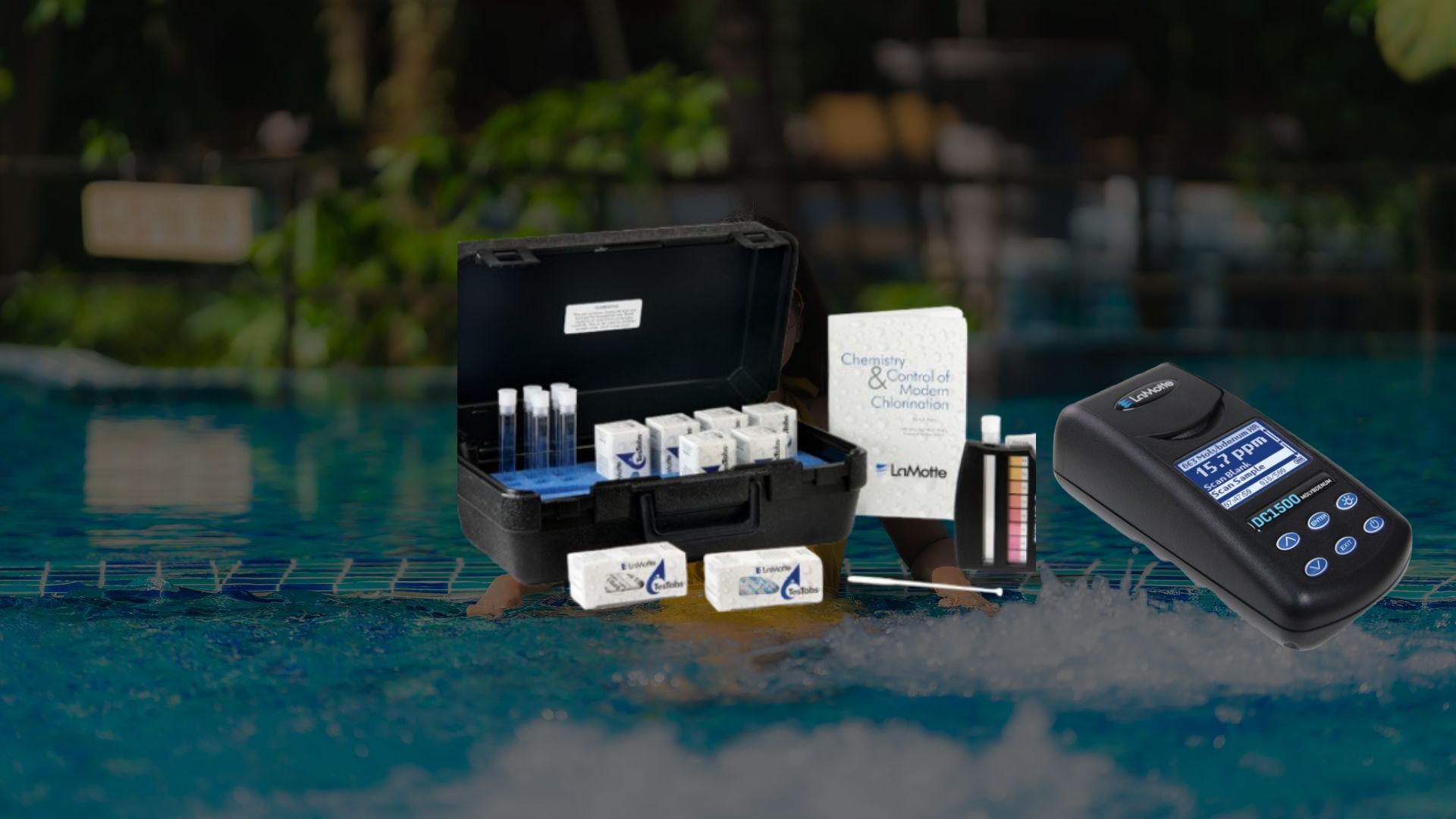
Below, we explore how three of LaMotte Pacific’s core products—the Chlorine (Free & Total) & pH Test Kit, the 2020i & 2020t Turbidity Meters, and the DC1500 Colourimeter—help elevate pool water quality across Australia.
Why Chlorine and pH Testing Are the Foundation of Pool Health
Chlorine: Australia’s most essential pool parameter
Chlorine remains the primary disinfection method in Australian pools. Its ability to inactivate bacteria, viruses, and organic contaminants relies heavily on correct concentration and chemical balance.
Australian state guidelines (including NSW Health and QLD Health) recommend:
- Free chlorine: typically 1.0–3.0 mg/L, depending on pool type
- pH: between 7.2–7.8 for optimal disinfection
However, chlorine effectiveness can vary by up to 80% based on pH alone. At pH 7.2, about 66% of chlorine exists as active hypochlorous acid. At pH 8.0, this drops to around 20%.
Meaning:
Even if chlorine levels look adequate, poor pH can cause major sanitisation failures.
The challenge for Australian pools
High UV exposure, saltwater chlorination systems, and variable source water often push pH upward. Commercial pools may also see chlorine lock, combined chlorine issues, and chloramine formation.
This increases the need for more reliable and frequent on-site measurement.
LaMotte’s Chlorine (Free & Total) & pH Test Kit: Accuracy You Can Trust
LaMotte Pacific’s Chlorine (Free & Total) & pH Test Kit gives pool operators clear, repeatable results through high-precision reagents and colour comparators.
Key advantages
- Measures both free and total chlorine, ensuring operators can detect combined chlorine early
- High-accuracy phenol red and DPD reagents, trusted in industry-standard pool operations
- Fast onsite results, suitable for daily or hourly monitoring
- Clear visual colour standards for reliable interpretation
- Suitable for commercial aquatic centres, service technicians, and residential pools
For anyone using a pool test kit in Australia, this kit helps maintain compliance, optimises chlorination efficiency, and prevents chloramine-related odour and irritation issues.
When to use it
- Daily testing for all pools
- Twice daily for commercial facilities
- After high bather loads or rain events
- When using automated chlorinators for manual cross-verification
Frequent manual testing remains critical even in facilities with electronic dosing systems, as regulatory guidelines require cross-checks in case of sensor drift.
Turbidity: The Critical Indicator of Water Clarity and Filtration Efficiency
While chlorine and pH ensure disinfection, turbidity ensures clarity, safety, and filtration performance. Turbidity reflects the presence of suspended particles—often too small to see but capable of harbouring pathogens, increasing chlorine demand, and reducing water appeal.
Why turbidity matters
Australian public pool guidelines typically mandate turbidity levels:
- <1.0 NTU for public pools
- <0.5 NTU for learn-to-swim facilities or hydrotherapy pools
Even slight increases in turbidity can signal:
- Filter inefficiency
- Coagulant/flocculant disruption
- Microbial growth
- Organic load from swimmers
- Residual metal or chemical issues
Industry studies show that pathogen survival rates increase in higher turbidity water—even when chlorine levels appear adequate—making this a vital parameter for compliance.
LaMotte 2020i & 2020t Turbidity Meters: Precision for Commercial Operations
The 2020i (infrared) and 2020t (tungsten light) turbidity meters from LaMotte Pacific provide laboratory-grade performance in a portable format.
Why these meters stand out
- Accurate from 0–1000 NTU, covering both clean water and troubleshooting scenarios
- Meets ISO 7027 (for 2020i) and EPA 180.1 (for 2020t) methodology
- High repeatability is critical for compliance reporting
- Backlit display for outdoor/bright environments
- Robust design suited for field or plant-room conditions
Operators using these meters can confidently adjust filtration systems, optimise flocculant dosing, and maintain compliance with health guidelines.
Applications
- Commercial aquatic centres
- Council pools
- Aquatic leisure parks
- Swim schools
- Hotels and resorts
- Large residential systems
This device is a benchmark for pool water testing equipment in Australia, where accurate turbidity tracking is required.
DC1500 Colourimeter: Expanding Beyond Basic Pool Chemistry
As more Australian facilities adopt data-driven maintenance, multiparameter digital instruments like the LaMotte DC1500 Colorimeter are becoming essential.
What makes the DC1500 valuable
The DC1500 offers high-accuracy digital testing for a range of critical water parameters, depending on the model configuration. These may include:
- Free & total chlorine
- pH
- Cyanuric acid
- Iron, copper, and manganese
- Alkalinity & hardness
- Phosphate
- Nitrate
- Turbidity (with compatible accessories)
Advantages for operators
- Digital results reduce human interpretation errors
- Stores and displays readings for record keeping
- Provides consistency across operators
- Works as a field lab for rapid onsite diagnostics
For facilities aiming to modernise operations without jumping directly to large-scale automation, the DC1500 forms the perfect bridge.
Building a Modern Water Testing Routine in Australia
Here’s an effective testing frequency for most commercial and community pools:
| Parameter |
Frequency |
Recommended Tool |
| Free & Total Chlorine |
2–3 times daily |
Chlorine & pH Test Kit / DC1500 |
| pH |
2–3 times daily |
Chlorine & pH Test Kit / DC1500 |
| Turbidity |
Daily for commercial pools |
2020i/2020t Turbidity Meter |
| Metals / Secondary parameters |
Weekly or monthly |
DC1500 Colorimeter |
A consistent routine reduces chemical costs, extends equipment life, and improves swimmer experience.
Accurate Testing Is the Backbone of Pool Safety
As pool operation becomes more complex across Australia, having reliable, professional-grade tools is no longer optional. Whether you rely on a pool chlorine test kit Australia, a broad pool test kit Australia, or advanced pool water testing equipment Australia, your results are only as good as the tools behind them.
For Further Enquiry Contact: sales@lamottepacific.com